MNRE Benchmark Cost
- MNRE updated benchmark cost to set the upper cap of the price of the GCRTSPV system for FY 2020-21
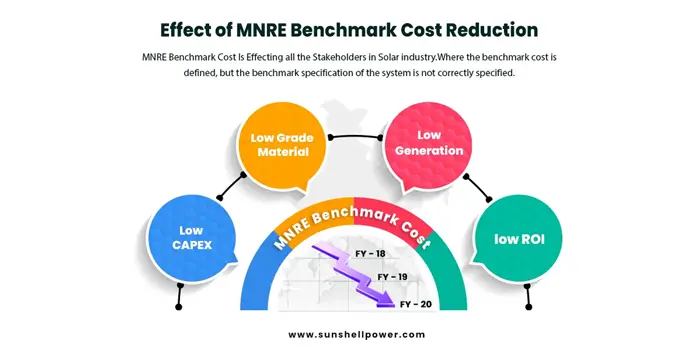
- No clarification on any benchmark specification of the solar system is provided
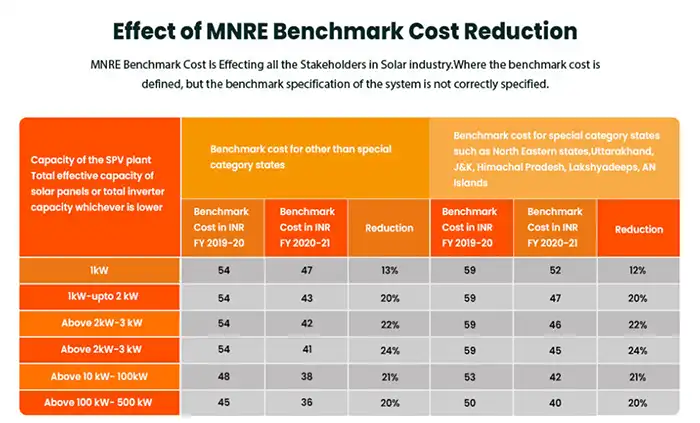
- The cost is average 20% lower than the benchmark cost of FY 2019-20
- Some unethical System integrators are offering low-quality materials and low quality to give the system within benchmark cost
- End customers are being affected, having received a more inadequate quality system, which results in lower ROI despite paying lower CAPEX
Like every year, MNRE has announced the benchmark cost for grid-connected rooftop solar power generating systems (GCRTSPV system) in India (vide OM No. 318/38/2018-GCRT Dated 21/07/2020) for FY 2020 – 21
Grid-connected rooftop solar rooftop power plant is the most cost-efficient system and is widely used by the residential and commercial sectors to reduce the electricity bill by capturing solar energy or the net metering facility.
To regulate the GCRTSPV system’s price, MNRE sets a cap on the pricing by implementing the benchmark cost. The price is reduced to a record low, which is shown below.
Here it can be noted that the above benchmark cost is included with total system cost including solar PV modules, inverters, BOS including cables and its accessories, Switches, Circuit breakers, connectors, JBs, module mounting structures (MMS), Earthing, Lightning arrestors, cost of Energy meters, local connectivity cost, cost of civil works, foundations, installation and commissioning, transportation, insurance, capital cost for online monitoring, comprehensive maintenance service for 5 years, applicable fees and taxes.
Aim of MNRE by reducing benchmark cost and its advantage
The aim of MNRE is apparent that the government aims to push solar power to get more affordable to reduce the carbon footprint and increase the clean energy generation by which the country can go forward to the 100GW RE installation target to be met by 2022. By imposing an upper cap on the price, the unethical system developers do not set high costs on the customer to increase their profit. The benchmark cost is also included in the transportation cost. This helps local suppliers an added advantage as if the transportation cost is high; the system integrator cannot offer the system within the set upper price cap.
Negative side of the Benchmark Cost
Such a benchmark cost make the system integrators to offer low-quality materials to keep the suggested price within the set upper price cap. The end customer usually lacks the technical knowledge to evaluate the technical proposal. If they find the price is within the government’s benchmark cost, they are convinced to purchase the system. But due to low-quality materials, they experience low yearly yield, Low PR, and low CUF from the system. After the 5 years, the product warranty and system integrator are no more responsible for any customer experience breakdown to bear high O&M costs. This results in an increased breakdown time and an increase in the payback period of the system. Thus, in the end, the benchmark cost is affecting the end customer.
Remedial Measure to be taken by MNRE
Govt./ MNRE should withdraw such order and research the solar market and set the benchmark cost considering the market price of the quality materials so that all the stakeholders of the market such as OEMs, system integrators, O&M service providers, customers, and government don’t face any problem with the quality and price of the materials and the consumer gets high value for the products they are getting. The system integrators get the desired return after selling quality products to the customer. MNRE should amend the order with an updated benchmark cost and also should include a benchmark specification to avoid any confusion or misunderstanding between system integrator and customer.