
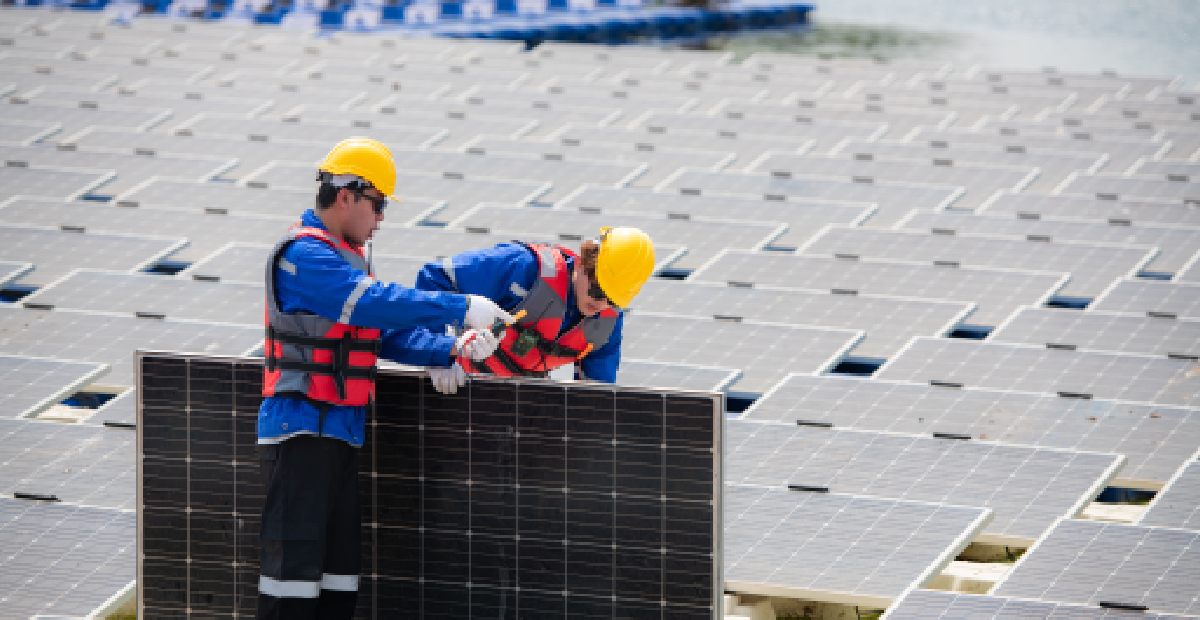
Diagram illustrating the end-to-end role of a Solar EPC Company in a solar power plant installation

Reducing commercial solar installation cost for your Industrial Solar Power Plant

3rd Oct, 2025

Synopsis

The Indian industrial sector requires industrial solar power plants because it needs substantial amounts of energy while working to reduce carbon emissions. The article examines methods to decrease commercial solar installation expenses while maintaining engineering quality through an analysis of initial capital costs versus future financial benefits. The path to optimal cost efficiency starts with accurate engineering design and becomes permanent when you choose a qualified Solar EPC Company . The article demonstrates how a skilled Solar EPC Company plays an essential part in building strong solar power plants and connecting them to the power grid. The article demonstrates how industrial solar rooftop arrays create stable energy costs from unpredictable grid prices. Industrial clients who plan their commercial solar power projects can protect themselves from rising energy costs and gain operational stability which shortens their investment return period.

The Indian industrial sector faces a crucial turning point because of increasing worldwide market requirements for sustainable manufacturing and unstable domestic power costs. The stability and affordability of power supply stands as the essential factor for large-scale manufacturers and energy-intensive units to stay competitive. The industrial solar power plant has evolved from an investment choice to a fundamental operational strategy requirement because of operational needs. The Indian energy sector continues to grow quickly because new renewable capacity installations will reach double their current levels by 2026 while solar power leads the expansion (Source: Industry growth projections). The national trend shows commercial solar power serving as the best protection against external economic factors because it provides enduring energy stability which enables industrial innovation to flourish.

The Industrial imperative: why solar power plant installation is essential

The traditional grid system creates ongoing problems for industrial operations because it produces power quality issues and causes regular power outages and imposes severe penalties for peak demand usage. The disruptions from the power grid result in major financial damage and production shortfalls for large manufacturing facilities. A solar power plant system that follows detailed planning provides uninterrupted power supply during daytime operation when most industrial facilities need electricity. The investment creates self-sustaining power generation at industrial sites which reduces dependence on traditional electricity networks. The strategic installation serves as a vital requirement for manufacturers who want to achieve their CSR targets because it enables them to reduce their carbon footprint and establish themselves as leaders in India’s industrial decarbonization efforts.

Decoupling cost from quality: the commercial solar installation cost paradox

Industrial buyers face their biggest challenge when they need to pay the high costs of commercial solar installation while ensuring long-term system performance. The use of substandard solar components for cost reduction purposes will result in reduced energy output and increased maintenance expenses and extended time to achieve full return on investment. The path to real cost savings emerges from well-designed projects and effective project management instead of selecting inexpensive equipment. The combination of bulk purchasing and standardized plant designs and solar engineering software enables project lifecycle optimization which produces lower commercial solar installation costs without compromising quality or extending equipment lifespan. The 25-year plant operation should focus on achieving the lowest possible Levelized Cost of Energy (LCOE) instead of concentrating on the first investment costs.

The Strategic Value of the Solar EPC Company

Industrial solar power plant development requires a complete project partner because of its complex engineering needs and strict grid requirements and complicated logistics systems. The Solar EPC Company functions as the master builder to deliver complete turnkey solutions through Engineering Procurement and Construction services. A trustworthy Solar EPC Company controls all project aspects starting with site feasibility evaluation and geotechnical studies and continuing through permit acquisition and grid connection authorization. The single point of responsibility in the EPC model enables effective project management while maintaining strict quality and safety standards (IEC and BIS codes) to deliver solar power plant installations on schedule and within budget. The EPC model represents the most effective method to build large industrial solar power plants successfully.

Design Excellence: Optimizing the Industrial Solar Rooftop

Industrial facilities have large areas of unused rooftop space that can support multiple megawatt solar installations without needing to purchase additional land. The optimization of this space needs detailed engineering work that includes structural load assessments and shading studies and exact panel positioning to minimize power output reduction. A strong industrial solar rooftop system provides facility protection from high-wind forces which maintains both operational safety and extended system lifespan (Structural Integrity and Compliance). The implementation of strong mounting systems and elevated structures raises the first costs of commercial solar installations but delivers better cooling performance and easier maintenance access which results in higher energy output and faster return on investment. The industrial solar rooftop asset reaches its maximum potential when roof space receives specialized design treatment that understands industrial requirements.

Financial Engineering: lowering the industrial solar power plant barrier

The implementation of commercial solar power depends on specialized financial solutions which target industrial customers for successful adoption. The OPEX/PPA (Power Purchase Agreement) model has gained popularity as an alternative to the standard CAPEX model because it provides maximum tax benefits through accelerated depreciation. The PPA model enables clients to skip paying the complete cost of commercial solar installation because they pay a fixed lower rate for each unit of solar power they use. The PPA model enables businesses to start saving money right away while they can allocate their funds to essential business operations. The financial stability of industrial solar power plants increases through government support that includes tax incentives and REC grants which make them attractive long-term investments with minimal financial risk.

Commercial Solar Power: beyond savings to stability

The main advantage of commercial solar power extends past electricity cost savings because it provides enduring stability in energy supply and fixed pricing. Businesses gain protection from fossil fuel price volatility through long-term electricity contracts that span 20-25 years. The stable nature of solar power systems allows businesses to create reliable financial projections which serve as essential tools for industrial planning over extended periods. The implementation of commercial solar power systems fulfills both environmental responsibility and ESG standards while satisfying clean manufacturing requirements from international supply chains.

The Sunshell blueprint for industrial efficiency

Our team handles each industrial solar power plant project as an individual engineering problem which requires us to optimize value delivery through effective management of total commercial solar installation expenses. Our approach as a strategic Solar EPC Company unites intellectual expertise with strict execution standards. Our team builds solar power plants that last through time while delivering peak performance by following strict quality control measures from start to finish. Our dedication to quality leads us to select durable materials and sophisticated structural designs which guarantee both extended operation and safe operation of your solar asset. Sunshell Power bases its operations on environmental stewardship and local ecosystem protection instead of profit maximization which drives our adoption of premium design standards and safety protocols for your long-term investment security.

A partnership for performance and decarbonization

Sunshell Power delivers industrial solar rooftop array and commercial solar power solutions through their expertise which stems from their knowledge of Indian regulatory systems and power grid complexities. Our energy consulting services provide transparent unbiased guidance to clients who need help choosing the best financing approach for achieving the quickest possible Return on Investment (ROI). The team of more than 30 service professionals at Sunshell Power delivers ongoing web-based monitoring and dedicated post-installation customer support to maintain reliable solar asset operation for extended periods. The integrated partnership model which covers feasibility assessment to ongoing maintenance operations delivers sustained performance while helping your company achieve meaningful decarbonization targets.

FAQs

The Solar EPC Company functions as the central point of responsibility for commercial solar installation cost management through their complete project oversight. The company uses their large-scale purchasing power to buy premium solar components such as panels and inverters at lower prices than what individual customers can obtain. Their specialized knowledge enables them to handle engineering and permitting and construction tasks efficiently which reduces project delays and construction errors. The EPC partner delivers a complete project solution that optimizes execution efficiency to protect the budget from cost increases. The complete management system enables the transformation of an attractive initial price into a successful project that stays within budget.

The installation of industrial solar rooftop systems provides businesses with a strong financial protection mechanism through the replacement of expensive grid electricity with self-generated power at minimal production costs. Industrial facilities that use commercial solar power systems gain protection from rising utility rates through fixed energy costs that span their 25-year system lifetime. The electricity produced becomes virtually free after the initial capital investment is recouped. The ability to predict operational expenses with certainty gives businesses a strategic market advantage because energy costs represent a major portion of their overhead expenses.

The 25-year operational life of solar power plants depends on non-optional quality assurance measures during installation. The installation process requires three essential steps which include thorough structural audits of the mounting surface and hot-dip galvanized steel structure selection for wind resistance and corrosion protection and complete compliance with IEC/BIS electrical safety standards. The system’s performance remains stable because high-quality installation techniques prevent both component deterioration and performance reduction from substandard connections and wiring errors. The system requires powerful lightning arrestors and earthing protection systems to defend against environmental dangers and grid instabilities which protect investments while ensuring maximum operational availability.

Industrial solar power plants provide factories with better advantages than staying connected to the grid for their electricity supply. The system provides manufacturing facilities with self-sustaining power which protects their essential operations from power outages and grid shutdowns that disrupt production schedules. The installation of commercial solar power systems leads to reduced operational expenses and quick financial returns because of net metering benefits and tax incentives that include accelerated depreciation. The implementation of commercial solar power systems helps factories achieve better sustainability performance which meets the strict ESG standards that global supply chain partners and investors demand.

The long-term financial analysis of commercial solar power reveals its overwhelming viability because it allows owners to calculate the complete ownership expenses. The justification for investment emerges from comparing solar energy LCOE to the continuously increasing prices of grid electricity. The business case becomes stronger when organizations have high electricity usage and qualify for net metering programs and access to financing options between CAPEX and OPEX. The justification for solar power investment goes beyond financial savings because it creates multiple benefits including energy security improvements and brand enhancement and sustainability compliance which enhance long-term enterprise value.

You might also like
Diagram showing the assembly layers in pv panel construction
15th Jan, 2026
The scientific genesis of a solar power plant from the construction of a solar cell

Synopsis The worldwide energy transformation depends on tiny photovoltaic effects which take place inside individual semiconductor wafers. This article traces the transformative journey from the precise construction of a solar cell to its scalable manifestation as a utility-scale solar power plant. We delve into the meticulous manufacturing stages that define quality and longevity in pv […]

View More...
Diagram showing the growth metrics of a successful solar power plant business
8th Jan, 2026
Scaling the solar plant business through intellectual capital and strategic consulting

Synopsis A sustainable solar plant business needs to establish itself in 2026 through installation capacity and requires both technical knowledge and ethical business practices. The blog provides essential methods for building a profitable solar power plant business which depends on an experienced solar power consultant to handle market challenges. Our method which combines data with […]

View More...
Diagram illustrating the water lift capacity of a Surface Solar Pump from a canal
6th Jan, 2026
The strategic evolution of the solar water pump in sustainable rural infrastructure

Synopsis Even as India faces steady challenges in accessing water and managing uneven shifts in energy costs, turning to solar-powered pumps has become unavoidable for long-term survival of farm economies. Rather than rely on old-school machinery, switching to clean-energy systems offers a clearer path forward – one tied directly to ensuring both power and food […]

View More...