Solar Street Lights and Mini Masts: Cost-Efficient Lighting for Urban and Rural India

13th Jun, 2025

Synopsis

India is making rapid progress in achieving its goal of sustainable infrastructure development through solar powered lighting systems for urban development and rural electrification. The blog article delivers a detailed examination of solar street lights together with solar mini high mast systems to show their ability to decrease energy dependence and improve safety and reduce ongoing maintenance expenses. Rural areas and smart cities across India have started using decentralised lighting systems to transform their nighttime public space illumination.The article starts by examining solar street lighting systems that consist of all-in-one solar street lights and semi-integrated solar street lights and traditional modular systems. The evaluation assesses each system through luminosity testing along with battery performance and weather resistance and installation simplicity and operational cost assessment to help municipalities and village panchayats select budget-friendly lighting solutions.

The article demonstrates how commercial solar street lights provide economic benefits when installed on roads as well as educational facilities and public trading areas and distant rural communities. The need for extensive coverage and elevated installations drives the adoption of solar mini masts and solar mini high mast solutions as adaptable alternatives. These solutions work best for extensive areas and busy areas that require uniform lighting. The post includes a complete analysis through discussions about pole height along with luminaire layout and solar panel angle and battery sizing.

The solutions help India achieve its sustainable urban development targets and rural electrification goals through the Smart Cities Mission and Saubhagya scheme. The article provides functional guidance to government entities along with EPC contractors and NGOs about decentralised lighting project development for public welfare delivery while reducing environmental impact and operational costs.


The Role of Solar Street Lights in Infrastructure 

The development of infrastructure depends heavily on lighting systems because they affect both road safety and nighttime commercial activities. The increasing demand for lower electricity expenses and environmental sustainability has led to the adoption of solar powered street lights as an efficient decentralized lighting solution. Solar lights operate independently from the grid because they produce and save energy during daylight hours which provides continuous lighting to areas with limited or no power access.

Key Types of Solar Street Lighting Solutions 

All in One Solar Street Light 

 The systems unite solar panels with battery storage and LED lighting and charge controllers into one unified compact device. These systems provide quick installation and low upkeep requirements which make them suitable for rural and semi-urban areas.

Semi Integrated Solar Street Light

The semi-integrated systems maintain panel and battery separation but simplify the installation process. These systems provide flexible customization options while maintaining integration

Commercial Solar Street Lights

The systems are designed for extensive projects which enable flexible component selection and improved illumination capabilities. The modular structure of these systems works best for highways and industrial parks and institutional campuses that need both high visibility and reliable operation.

Designing Efficient Solar Mini Mast Systems

Understanding Solar Mini Masts

The solar mini mast system includes elevated poles reaching heights between 9 and 12 meters which use high-lumen LED fixtures that draw power from solar panels and battery storage systems. The lighting system uses circular placement to achieve broad illumination coverage.

System Components and Site Planning 

The system requires proper placement of its components along with sufficient sunlight exposure and appropriate pole spacing and luminaire wattage and battery autonomy and wind load tolerance. The specified parameters lead to maximum system performance while reducing system downtime and extending its operational lifespan.

Performance and Cost Analysis Across Use Cases 

The price of solar powered street lights and mini masts depends on their capacity and the quality of components and local climatic conditions. The initial investment for solar lighting seems higher than conventional lighting at first but the electricity and maintenance savings over time make solar power a better option. The initial investment for semi integrated and all-in-one systems is lower but commercial solar street lights offer better return on investment for areas with dense population or high traffic volume.

 Public Safety, Energy Savings, and Social Impact

The installation of solar lighting systems enhances visibility in dangerous areas which leads to fewer accidents and less criminal activity. The illumination of villages and urban slums enables nighttime community activities and safe nighttime movement. The systems decrease the pressure on power grids which helps achieve national energy efficiency goals and decreases diesel usage in areas without electricity.

Applications in Urban and Rural Scenarios 

Urban Smart Cities 

Solar lighting in cities works together with smart grid solutions to help achieve climate action targets and provides continuous illumination when the power grid fails.


Rural Electrification

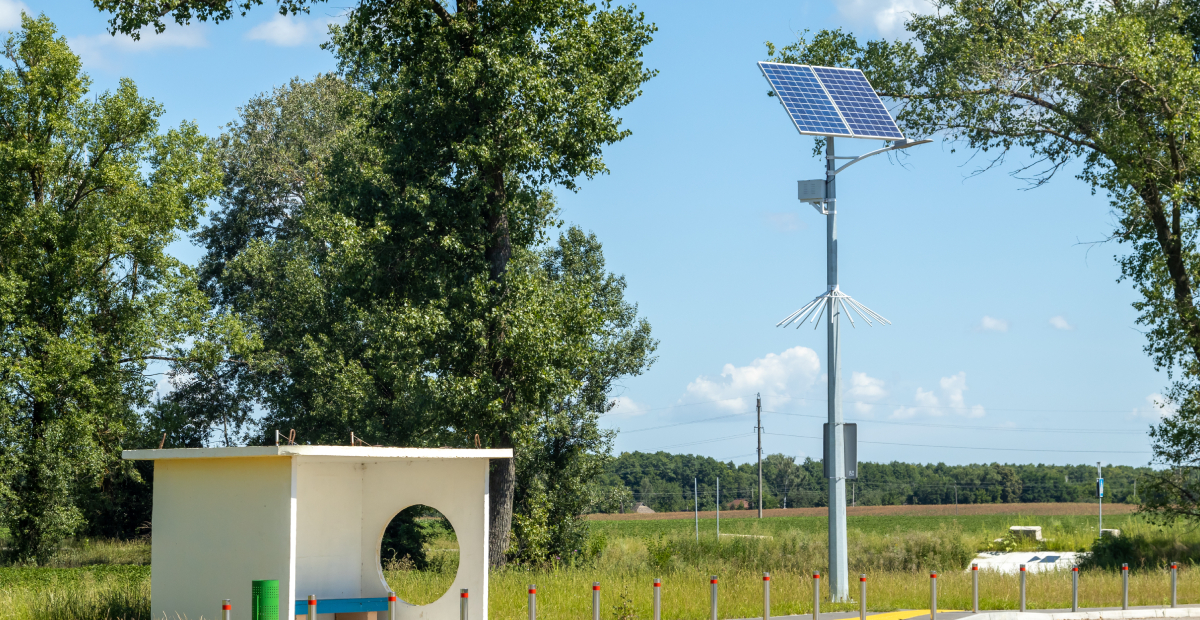
Solar mini high mast installations provide light and security to villages without reliable power by illuminating public squares and bus stands and outdoor gathering spaces that previously used kerosene or generators.

Challenges in Implementation and O&M 

The maintenance needs of solar lighting systems are low but users must address theft issues and battery degradation and panel cleaning and the lack of local service teams. The combination of tamper-proof installations with remote monitoring technology helps address these challenges to extend system lifespan.

 A Strategic Solution for India’s Lighting Goals 

India needs lighting solutions that are decentralised, eco-friendly, and quick to deploy because it has more than 600,000 villages and 100+ smart cities. Solar street lights and solar mini masts meet these criteria while supporting national missions. Their modularity allows customisation to diverse terrains and use cases, making them an indispensable part of India’s energy transition strategy.

FAQs

Solar powered street lights provide three main advantages: they reduce dependence on grid power, decrease electricity expenses and deliver consistent light in areas without traditional power supply. These lights serve two purposes by supporting environmental sustainability and enhancing security in public areas.

The compact and simple installation process of all in one models results from their integrated components. The battery and panel function as separate components in semi integrated systems which provide better heat management and installation flexibility for mid-scale projects.

The solar mini mast represents a high pole lighting system that uses solar power to illuminate extensive areas including village centers and markets and parking lots. The system provides broad lighting coverage together with improved visibility.

The solar mini high mast systems decrease electricity expenses while needing minimal upkeep. The systems provide quick deployment and scalability to areas with unreliable or non-existent grid power making them suitable for rural regions.

The systems require scheduled solar panel cleaning and battery health assessments together with occasional substitutions of LED fixtures and charge controllers. Modern systems have been engineered to operate for extended periods with minimal maintenance requirements.

You might also like
Diagram showing the assembly layers in pv panel construction
15th Jan, 2026
The scientific genesis of a solar power plant from the construction of a solar cell

Synopsis The worldwide energy transformation depends on tiny photovoltaic effects which take place inside individual semiconductor wafers. This article traces the transformative journey from the precise construction of a solar cell to its scalable manifestation as a utility-scale solar power plant. We delve into the meticulous manufacturing stages that define quality and longevity in pv […]

View More...
Diagram showing the growth metrics of a successful solar power plant business
8th Jan, 2026
Scaling the solar plant business through intellectual capital and strategic consulting

Synopsis A sustainable solar plant business needs to establish itself in 2026 through installation capacity and requires both technical knowledge and ethical business practices. The blog provides essential methods for building a profitable solar power plant business which depends on an experienced solar power consultant to handle market challenges. Our method which combines data with […]

View More...
Diagram illustrating the water lift capacity of a Surface Solar Pump from a canal
6th Jan, 2026
The strategic evolution of the solar water pump in sustainable rural infrastructure

Synopsis Even as India faces steady challenges in accessing water and managing uneven shifts in energy costs, turning to solar-powered pumps has become unavoidable for long-term survival of farm economies. Rather than rely on old-school machinery, switching to clean-energy systems offers a clearer path forward – one tied directly to ensuring both power and food […]

View More...