Synopsis
The adoption of solar water pumps in Indian agriculture has brought about a transformation by using solar power instead of diesel engines and grid-tied motors to provide affordable emission-free irrigation solutions. The blog examines the dual benefits of solar water pumps which lower operational expenses and expand irrigation networks in areas with inconsistent power supply. The article describes the design features and operational suitability of surface pumps and solar submersible pumps and open-well variants and solar powered surface pumps for different land topographies and water depths and crop patterns. The article evaluates solar submersible water pump technology for deep water tables while emphasizing the essential efficiency improvements that become crucial during periods of unpredictable rainfall. Public-private partnerships through government subsidy programs including PM-KUSUM and pilot schemes prove successful in expanding solar irrigation systems to larger scales. The transition to solar powered pumps leads to increased yields and stable farm income and reduced diesel emissions according to field data and case studies. The article presents solar pumps as a workable agritech solution for sustainable farming by addressing cost aspects and performance capabilities and policy realities.
Table of Contents
The Irrigation–Energy Nexus in Indian Farming
The agricultural sector in India consumes about 18 percent of the total electricity supply and 1.5 billion liters of diesel each year for irrigation purposes. India’s installed base crossed 420,000 solar pumps under PM-KUSUM by March 2025, up from 100,000 in 2020; Rajasthan alone hosts 35 % of units.
From Diesel to Solar Water Pumps: Cost & Emissions Shift
Running a 5 HP diesel pump costs farmers ₹2,20,000 in fuel over ten years; a solar water pump of equivalent capacity has zero fuel cost and breaks even in three to four seasons. A cost-comparison study found 20-year irrigation expenses drop by 65 – 75 % when diesel is replaced by a solar powered pump. Besides cost, each solarised pump avoids roughly five tonnes of CO₂ per year—matching the annual emissions of a passenger car.
Types of Solar Pumps and Suitability Matrix
-
Surface solar pump: Ideal for shallow wells and canal lift up to 8 m.
-
Solar submersible pump: Works at depths of 10 – 70 m; preferred for borewells.
-
Open-well submersible: Sits at the bottom of open wells to minimise suction losses.
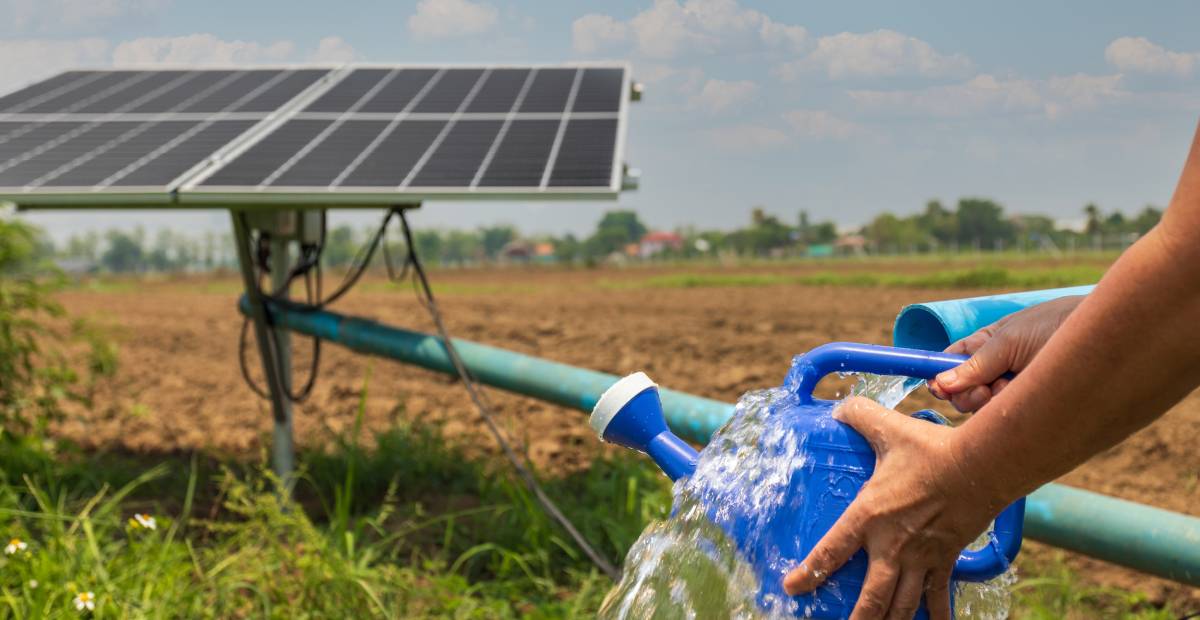
Solar powered surface pump (DC/AC options): Powers drip or sprinkler networks for orchards and vegetable farms.
Pump selection hinges on static water level, daily discharge need, and crop water demand.
Performance Insights: Submersible vs Surface Pumps
The results of field tests demonstrate that solar submersible pumps operate at hydraulic efficiency levels between 28% and 65% whereas DC surface solar pumps operate at efficiency levels between 30% and 50%. The flow rate of submersible designs remains stable when the water table changes by ±5 meters but surface variants experience efficiency decline after 6 meters of suction. The use of groundwater cooling extends the operational life of motors in solar submersible water pumps.
Government Schemes and Financing Pathways
The PM-KUSUM Component-B provides funding for up to 60% of pump capital expenditures through central and state government contributions of 30% each. The remaining balance of NABARD credit lines is available at concessional rates while carbon-credit revenues provide additional funding for maintenance. The government has sanctioned more than 500,000 new pumps for FY 2025–26 with a focus on states that receive high solar irradiance. The pay-per-use payment system enables tenant farmers to access irrigation services through pump ownership without restrictions so landless groups can benefit from the program.
Case Studies: Yield and Income Impact
The 7.5 HP solar submersible pump in Sikar, Rajasthan, allowed two additional crop cycles per year; net farm income increased by 38 %. The 3 HP solar powered surface pump operated by a cooperative in Uttar Pradesh saved ₹1.2 lakh in diesel costs each year while reducing irrigation labor by 17 %. The research data from 107 adopters showed that diesel consumption decreased by 55% on average while vegetable production increased by 20%.
Scaling Challenges and Mitigation Strategies
The main obstacles to solar energy plant implementation include expensive initial costs and restricted maintenance services in distant locations and the potential for excessive groundwater extraction. Mitigation involves:
-
Aggregating demand through FPOs for bulk discounts.
-
Training local technicians for O&M to protect pump uptime.
-
Linking pump subsidy disbursal to drip-irrigation adoption, reducing water stress.
-
Smart controllers enable daily pumping hour limits which unite energy access with water conservation practices
SunShell Power: Delivering Bankable Solar Pump Projects
SunShell designs turnkey pumping solutions using tier-1 PV modules, MPPT drives, and IoT-enabled flow monitoring. Our engineering team determines the correct size of solar submersible pump arrays to provide continuous discharge throughout the year even when monsoon skies become hazy. Our bundled services that include An error occurred while processing your request. Please try again.
Why SunShell Is the Partner of Choice
-
The system enables fast installation through regional warehouses combined with pre-assembled kits.
-
Every solar powered pump contains long-life brushless DC motors.
-
The system provides predictive maintenance alerts to help surface solar pump users reduce equipment downtime.
-
The system generates data-based impact reports which help NGOs and agri-lenders who invest in sustainable irrigation projects.
-
SunShell provides dependable water access to farmers while financiers achieve strong IRRs and India advances toward eliminating diesel from its agricultural sector.
FAQs
How does a solar water pump differ from a diesel pump in lifetime cost?
A diesel pump’s fuel outlay over ten years can exceed the entire capex of a solar water pump; solar systems incur only minor O&M expenses.
When should a farmer choose a solar submersible pump over a surface pump?
Select a solar submersible pump when water depth exceeds 10 m or fluctuates widely; use a surface solar pump for shallow sources below 8 m.
Are subsidy programmes available for solar powered pumps nationwide?
Yes. PM-KUSUM covers up to 60 % of cost, and several states add top-ups, making solar powered pump adoption more affordable.
Does a solar submersible water pump work during cloudy weather?
Yes. Oversized PV arrays and MPPT controllers maintain adequate flow; hybrid setups can employ grid or battery backup when needed.
How do solar powered surface pumps support drip irrigation?
Their steady, moderate pressure pairs well with drip lines, delivering uniform moisture while conserving water and energy.