Synopsis
For the CFO of 2026, understanding the commercial solar power plant balance sheet is no longer about sustainability alone—it is a critical requirement for fiduciary excellence. This blog conducts a detailed audit of the current solar energy plant cost versus 25-year projected returns, providing a data-driven roadmap for industrial investment. We break down the cost of commercial solar panels in the 2026 market, highlighting how falling module prices and high-efficiency N-type technology have shortened payback periods to just 3.5 to 4 years. The post explores the strategic advantages of commercial rooftop solar depreciation, including the 40% accelerated depreciation benefit that serves as a massive tax shield for Indian enterprises. We analyze the operational impact of commercial solar panels installations, demonstrating how self-consumption models provide a permanent hedge against rising grid tariffs. Readers will gain insight into why selecting a top-tier solar power plant company is the most important variable in securing project bankability and long-term internal rates of return (IRR). Discover how Sunshell Power leverages technical authority to transform your underutilized roof into a high-yielding financial asset, ensuring your energy strategy delivers predictable dividends and total energy sovereignty for decades to come.
Table of Contents
The 2026 Financial Shift: Energy as a strategic asset
What was once viewed as simply paying a utility bill has become a major cost driver for many industry sectors as they work to manage their operating expenses in the face of highly volatile grid tariffs. For large industry, understanding the costs and impacts of energy procurement has become as important as managing inventory or labor hours. Installing a commercial solar power plant in 2026 is a fixed-cost asset that can convert an unpredictable operating expense to a fixed expense, prepaying for a portion of a company’s future energy needs at lower than current grid tariffs. This approach to energy generation can keep money flowing to the core business mission, rather than being lost to rapidly increasing and unpredictable utility bills.
Auditing the commercial solar power plant: A CFO’s perspective
When undertaking a financial audit of a commercial solar power plant, the most critical metric that needs to be considered is the Levelized Cost of Energy or in short LCOE. For a professionally engineered solar asset in 2026, this is as low as ₹2.0 to ₹2.5 per unit as against the industrial grid tariffs of ₹8.50 per unit plus or as the case may be. This large gap amongst the two price points makes for a very compelling business case for industries to invest in a capital intensive field such as solar. An important aspect to consider is the IRR or in short the Internal Rate of Return that an investor can expect from a CAPEX owned solar installation. For the power and telecom industry this is not just high but is also stable and measurable and stands at 25-30% + IRR. This means that the “payback to production” ratio is under four years of installation. So what does the company gain over these four years? A lot of free or low cost energy over a period of time that extends well into two decades plus.
Breaking down solar energy plant cost: CAPEX vs OPEX
Having an understanding of the solar energy plant cost is an important aspect in choosing the right ownership model for your solar power plant. Although the preferred model for going solar in India is still the CAPEX (Capital Expenditure) model in 2026 as it yields the highest savings in the long run, corporations with deep pockets can opt for full control and ownership of the solar energy plant. The other alternative ownership models are the OPEX or PPA (Power Purchase Agreement) model that allows companies to go solar with ZERO upfront cost for the solar energy plant. However, companies can purchase discounted solar power from a developer who will design, build, operate and maintain the solar power plant for the life of the contract. At Sunshell Power, we will provide you with a detailed fiduciary comparison that will help you understand the implications to your company’s cash flow and your long term tax planning.
The cost of commercial solar panels: Investing in long-term yield
The cost of commercial solar power plant modules have softened significantly in early 2026 as supply chains worldwide have become more efficient and manufacturers have moved to higher efficiency, high performing, high density, Hard-Mask N-type TOPCon cells to meet increased capacity. While the lowest initial cost may appear to be the best option for the up-front investment, there can be hidden costs to the project. High performance commercial solar modules achieve over 87% of MPP in year 25 compared to less than 80% for lower quality options. Selecting the highest quality, Tier-1, commercial solar panels for your solar power plant will save you significant losses in IRR due to degradation and provide a bankable return on investment.
Commercial rooftop solar: Maximizing tax efficiency and cash flow
For Indian industries, commercial rooftop solar presents one of the biggest tax saving opportunities. The upcoming tax regime of 2026 will allow Indian industries to claim 40% capital lapse under accelerated depreciation in the first year itself. This means that businesses can reduce their taxable profits by 40% of the energy plant cost in the first year itself. This alone is a huge incentive. On top of this, the GST on commercial solar panels can be claimed as an input tax credit (ITC) – one of the only categories that enjoys this privilege. Clearly, commercial rooftop solar presents an exciting investment proposition, not only to save money in the short-term on reduced electricity overheads but also in lowering a company’s overall corporate tax liability. This makes it highly relevant for MSMEs as well as larger-scale manufacturing companies.
Why a leading solar power plant company is key to bankability
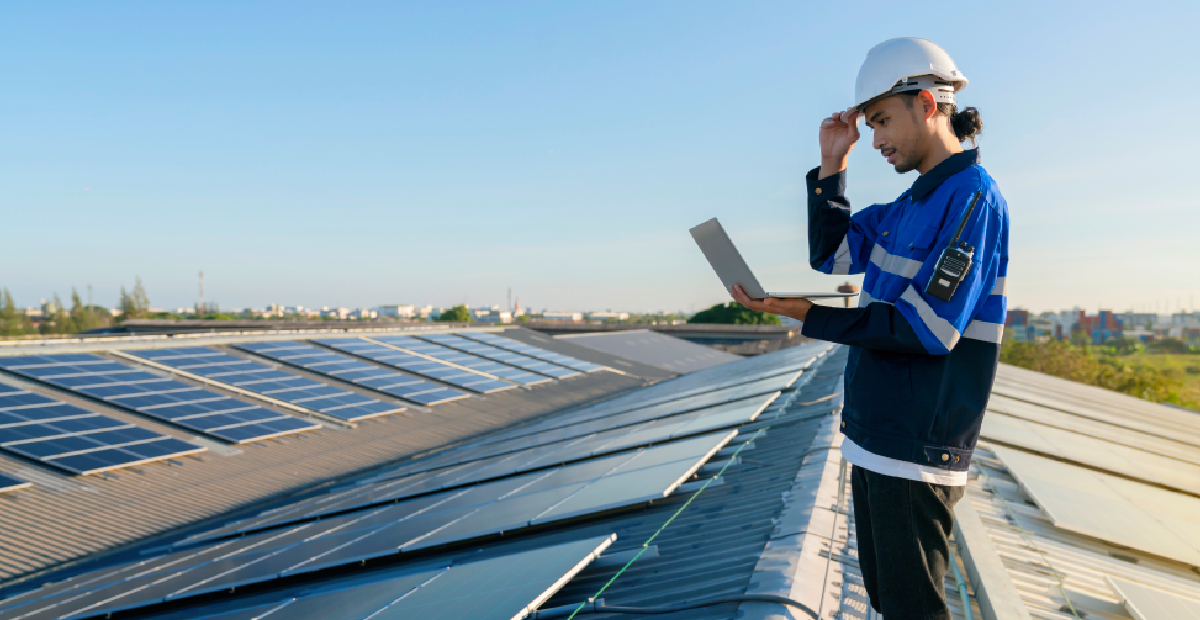
For long-term profitability of a Solar Power Plant project, it is very important for the execution partner i.e. Solar Power Plant company to be adequately expert in execution. The execution partner should not only be able to complete the installation of solar panels in correct manner, but also should design the project technically correct and should be able to present it as project bankable to get finance for the same. For commercial rooftop solar panels installation, the good execution partner would first carry out a proper structural load-bearing check before starting installation. The good execution partner would design the electrical setup of Solar Power Plant, to handle industrial loads for and from plant and would make sure that the completed commercial solar panels installation is safe for humans and would generate expected power and not cause any health hazard. A good execution partner will make sure that the power plant is built with appropriate IS and IEC standards and will convert your saving in thought to saving in pocket.
SunShell Power: Your partner in fiduciary energy excellence
SunShell Power provides technical and financial acumen to build highest yielding commercial solar power plant using industrial grade Tier-1 hardware. We clearly articulate the solar energy plant cost to our clients and help them decide between CAPEX and OPEX models. Right from the Feasibility Audit to Financial Closure, EPC contracting to Commissioning and O&M of solar energy plant, we strive to extract every watt of energy to maximize Return on Investment for our clients. Our solar energy solutions empower Indian businesses to become energy independent and turn their energy overhead into a permanent source of strength.
Conclusion: Securing a high-performing energy legacy
For industrialists who wish to leave a long-term energy legacy that is both environmentally sustainable and highly profitable in today’s highly competitive high-demand energy market, switching to solar is a necessity. By leveraging the tax benefits of commercial rooftop solar and the decreasing costs of commercial solar panels, businesses can create a future that is independent and sustainable. SunShell Power provides world-class solar energy development and engineering services to industrialists seeking a high performing and bankable commercial solar energy solution that maximizes tax shields while reducing the solar energy plant cost.
FAQs
What is the typical payback period for a commercial solar power plant?
In 2026, the typical payback period for a commercial solar power plant in India ranges from 3.5 to 4.5 years, depending on the state-wise utility tariff and the system’s efficiency. With the cost of commercial solar panels having stabilized, businesses can recover their initial solar energy plant cost very quickly through direct savings on electricity bills and tax incentives like accelerated depreciation. After the payback period, the electricity generated by the commercial rooftop solar system is effectively free for the remainder of its 25-year lifespan. This provides a massive, long-term boost to the company’s profitability and cash flow.
How does accelerated depreciation reduce the solar energy plant cost?
Accelerated depreciation is a major fiscal incentive that allows businesses to claim 40% of the solar energy plant cost as a tax deduction in the first year of operation. For an enterprise in the 30% tax bracket, this can result in a tax saving equal to nearly 12% of the total commercial solar power plant investment. When combined with the input tax credit on GST for commercial solar panels installations, the net effective solar energy plant cost is significantly reduced. This tax shield improves the project’s Internal Rate of Return (IRR) and makes commercial rooftop solar one of the most financially attractive infrastructure investments in 2026.
Is a commercial solar power plant better for CAPEX or OPEX ownership?
The choice between CAPEX and OPEX depends on the business’s financial strategy and cost of capital. A CAPEX-owned commercial solar power plant offers the highest long-term savings and allows the company to benefit directly from tax incentives and REC (Renewable Energy Certificate) income. However, for firms that prefer to keep their capital for core business expansion, the OPEX model provides a zero-upfront solar energy plant cost solution with immediate savings of 30-45% on bills. As a specialized solar power plant company, we help you model both scenarios to determine which approach delivers the maximum fiduciary value for your specific facility.
What determines the quality and cost of commercial solar panels?
The cost of commercial solar panels is influenced by the cell technology (N-type vs P-type), the module efficiency, and the manufacturer’s warranty terms. In 2026, Tier-1 commercial solar panels are highly recommended because they offer lower degradation rates and higher thermal resilience in the Indian climate. While these modules may have a slightly higher upfront cost of commercial solar panels, they generate more power over 25 years, leading to a much lower LCOE. High-quality commercial solar panels installations also include robust bypass diodes and weather-sealed frames, which prevent the “hot spots” and micro-cracks that can compromise the project’s bankability.
Can a commercial solar power plant company help with REC and Carbon Credits?
Yes, a professional solar power plant company can assist in the registration and monetization of Renewable Energy Certificates (RECs) and Carbon Credits. By installing a commercial solar power plant, businesses generate “Green Energy” that can be traded on the open market, providing an additional revenue stream beyond bill savings. In 2026, with the tightening of global ESG norms, the value of these credits has increased significantly. Leading commercial solar panels installations are now equipped with smart meters to track and verify this generation, allowing the company to demonstrate its carbon reduction and improve its brand reputation in the global marketplace.