Synopsis
In the smart cities of 2026, public safety and energy efficiency are being redefined by advanced outdoor lighting solutions. This blog serves as a definitive guide to selecting the best solar street lights for modern municipal and commercial infrastructure. We explore the rapid transition from traditional grid-tied lamps to integrated solar street lights, which combine a PV module, a high-density lithium battery, and a precision-engineered LED in a single, compact housing. The post delves into the technical advantages of commercial solar street lights, focusing on their ability to provide decentralized, fail-safe illumination without the need for expensive trenching or cabling. We examine the broader category of solar street lights and how their “plug-and-play” nature significantly lowers installation timelines. Additionally, we analyze the role of the solar mini mast in providing high-intensity wide-area lighting for intersections and industrial yards. Readers will understand how Sunshell Power leverages technical authority to deploy solar powered street lights that utilize intelligent motion sensors and dimming profiles to maximize battery life. Discover why choosing high-performing lighting assets is a critical step toward achieving 2026 urban sustainability goals, ensuring every street is illuminated with clean, reliable, and cost-effective power.
Table of Contents
The 2026 Urban Shift: Why decentralized lighting is the baseline
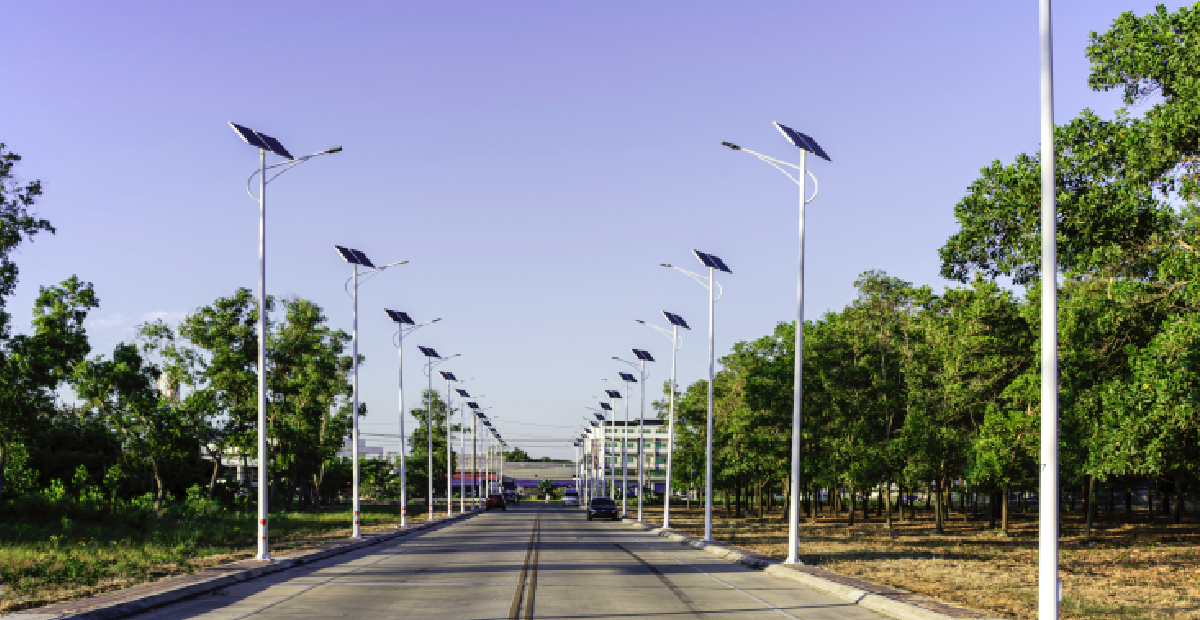
As populations continue to urbanise and the cost of energy rises, the demands on power supply are increasing. Municipalities and developers are seeking to reduce their dependence on the grid, and in many countries around the world, solar powered street lights have become the default choice for such infrastructure projects. Solar powered street lights offer a standalone solar solution which is energy positive, meaning that the lighting will power itself to zero cost. In addition, the installation costs are dramatically reduced as there is no need for underground cabling and associated expensive trenching. Solar powered street lighting is a solution that can deliver lighting, sustainability and support carbon neutrality targets.
Anatomy of the best solar street lights: LEDs, batteries, and controllers
When selecting the best solar street lights it is important to understand the 3 core components that have come to define the street lighting of tomorrow: The PV module, the storage unit and the light engine. With the latest guidelines provided by the technical authority of lighting in 2026, recommending the use of high-efficacy LEDs with minimum efficacy of 200 lumens per watt, it is vital that all street lighting including solar options have the highest lumen output to guarantee road safety. To ensure the best solar street lights have the greatest lifespan it is crucial that the storage unit houses a Lithium Iron Phosphate (LiFePO4) battery which has superior cycle life and thermal stability than the commonly used lead acid and nickel cadmium batteries. The smart MPPT (Maximum Power Point Tracking) charger in the best solar street lights allows for efficient charging on a cloudy day as well as drop in ambient light level to ensure your lighting asset is a reliable investment for over a decade.
The rise of integrated solar street lights: All-in-one efficiency
The innovative improvements to Solar Street Lighting over the past few years has culminated into emergence of what we call today as Integrated Solar Street Lights. Also known as All-in-One Solar Street lights, these compact systems contain solar panel, battery and LED in a single cabinet making it very easy to install and reduce the soft costs by almost 50% by not requiring battery box and complicated wiring etc. These modern street lights are designed to be robust, vandal resistant and shielded to protect its contents from environmental, sun, rain, tampering etc. powers. Integrated Solar Street Lights are super-efficient, compact and provide high quality lumen output and are best suited for modern residential townships and commercial parks of tomorrow as mandated by 2026 smart cities.
Commercial solar street lights: A fiduciary choice for smart cities
For Project Managers and for CFOs of government bodies and companies, solar street lights are a financial decision. Even though the initial investment cost for solar street lights might be higher than traditional options, the Total Cost of Ownership (TCO) is lowered. No copper wire or electrical panels to deploy and most importantly, there is no utility bill to pay. As a result, the payback period for commercial solar street lights is typically less than 3 years. Many municipal authorities are using the savings on street lighting to invest in other critical infrastructure projects by 2026. However, the return on investment for solar street lights is a fiduciary-grade investment in a high quality street light technology with long warranties and ultra low maintenance.
Solar street lights vs grid-tied: A lifecycle cost comparison
Compared to Grid-Tied Lighting, Solar Street Light installation is from installation to operation quicker. Our team completed a 100 pole solar street light installation in a matter of days. In traditional lighting, as the price of fossil fuels increases, the expenditure for installation of such lighting also increases. But with Solar Street Light, there is no monthly expenditure for 25 years and reduced labour cost which makes it the best option for public lighting and other high usage applications in 2026 and beyond.
Illuminating large areas: The role of the solar mini mast
Regular poles are fine for streets and off-road installs, but larger areas such as intersections, parking lots or industrial sites need a light pole that’s built stronger and has more features for additional lighting and power components. Typically, these extra large light poles are installed at a greater height and feature one or more high-powered LED luminaires in addition to a larger solar panel. In 2026, solar powered mini masts efficiently and cost-effectively provide light and security for industrial sites and urban spaces like municipal plazas. By concentrating large amounts of energy capture into a single, upright mast, solar mini masts provide a cost-effective alternative to installing multiple smaller poles which add to installation costs.
SunShell Power: Your authority in public energy infrastructure
A Infrastructure of Dignity with the right lighting solutions. SunShell Power offers the best solar street lights specifically designed for the Indian conditions. The right blend of LEDs, wattage and battery type (LiFePO4) in our commercial solar street lights ensure the best performance. We conduct a site audit to determine the correct spacing and Lux levels for the project. We also provide our clients with the correct information to gauge the return on investment over time as compared to traditional street lighting systems. This can range from a handful of lights to power a residential street, a solar mini mast to light up an industrial yard or a solar pole lamp to illuminate a rural road.
Conclusion: Lighting the path to a sustainable urban future
Solar powered street lights are a rewarding solution for the modern city that desires a resilient and independent infrastructure. Solar street lights offer a carbon emissions reducing, cost saving and safe solution for all urban environments. SunShell Power offers quality solar street lights for any application. We start by selecting off the shelf solar street lights and can design a fully custom city wide solution to meet your specific needs. Our solar lighting solutions deliver unparalleled performance, maximize return on investment and deliver a bankable result for our clients.
FAQs
How do integrated solar street lights perform during rainy or cloudy weather?
Modern integrated solar street lights are designed to maintain consistent illumination even during prolonged periods of low sunlight. In 2026, the best solar street lights utilize advanced MPPT controllers that can harvest energy even from diffuse light. Furthermore, these solar powered street lights are equipped with high-capacity LiFePO4 batteries that provide 3 to 5 nights of “autonomy,” meaning the lights will function even if there is zero sunshine for several consecutive days. Intelligent dimming sensors further conserve energy by reducing brightness when no motion is detected, ensuring that your solar street lights remain active throughout the rainy season.
What is the typical lifespan of commercial solar street lights?
Professional-grade commercial solar street lights are built for long-term durability, with a design life of over 10 to 12 years. The LED light engine in the best solar street lights typically lasts for 50,000 to 100,000 hours, while the LiFePO4 batteries are rated for over 2,000 charging cycles. The solar panel itself has a performance lifespan of 25 years. Because integrated solar street lights have no external wiring and are housed in IP65 or IP67-rated casings, they are highly resistant to moisture, dust, and corrosion. This makes solar powered street lights a highly reliable, low-maintenance asset for any municipal or industrial infrastructure project.
Are solar street lights more cost-effective than traditional electric lights?
Yes, when looking at the total lifecycle cost, solar street lights are significantly more cost-effective. While the initial purchase price of commercial solar street lights might be higher, you completely eliminate the costs of trenching, cabling, and monthly electricity bills. In a large-scale project, these “hidden” costs of traditional lighting can double the initial budget. By using integrated solar street lights, you achieve a payback period of 2-3 years through energy savings alone. Over a 10-year period, solar powered street lights can save a municipality or business lakhs of rupees in operational and energy expenses.
What is the difference between a standard street light and a solar mini mast?
The primary difference lies in the height and the area of illumination. A standard fixture in the best solar street lights category is designed for roads and paths, usually mounted at 4 to 6 meters. In contrast, a solar mini mast is a high-mast solution mounted at 7 to 9 meters, carrying multiple powerful LED luminaires. The solar mini mast is engineered for wide-area coverage, such as city squares, industrial yards, or large intersections. It uses a larger solar array and battery bank to provide higher lux levels over a 360-degree radius, making it a more efficient choice for wide-open spaces compared to multiple smaller poles.
How difficult is it to install integrated solar street lights?
One of the biggest advantages of integrated solar street lights is their extreme ease of installation. Since the panel, battery, and light are all in one unit, there is no external wiring required. A standard pole can be fitted with integrated solar street lights in less than 30 minutes. This “plug-and-play” nature allows for rapid deployment in remote areas or locations where grid access is limited. As a leading solar power plant company, we provide turnkey installation services for commercial solar street lights, ensuring each pole is positioned for maximum solar exposure and optimal light distribution, providing a high-performing lighting network with minimal site disruption.