Synopsis
The blog provides an extensive evaluation of floating solar power stations operating within Indian territory. The text describes the necessary design elements for placing floating arrays on water bodies including reservoirs and lakes and canal surfaces. The discussion explains how floating solar power plants generate electricity through anchoring and mooring systems and panel cooling benefits that avoid land usage. The lifecycle economics of floating solar power depends on three main factors: logistics expenses and water-body selection and O&M profiles. The existing projects in Kerala and Maharashtra offer valuable lessons and policy insights. The assessment of performance factors including sunlight reflection and module degradation and water-evaporation control demonstrates the project’s viability. Floating solar technology presents itself as a promising yet underutilized solution to address India’s expanding land limitations for clean energy infrastructure.
Table of Contents
Why Float? India’s Land-Efficiency Imperative
The growth of solar capacity needs to happen quickly but it should not come at the expense of agricultural land. The installation of floating photovoltaic (FPV) modules on water surfaces that are not in use enables the coexistence of hydropower dams and large reservoirs while preserving land for farming purposes. The installation of solar capacity on a small portion of India’s major reservoirs would generate multiple gigawatts of power while maintaining land availability for farming purposes.
Core Design Elements and Technical Standards
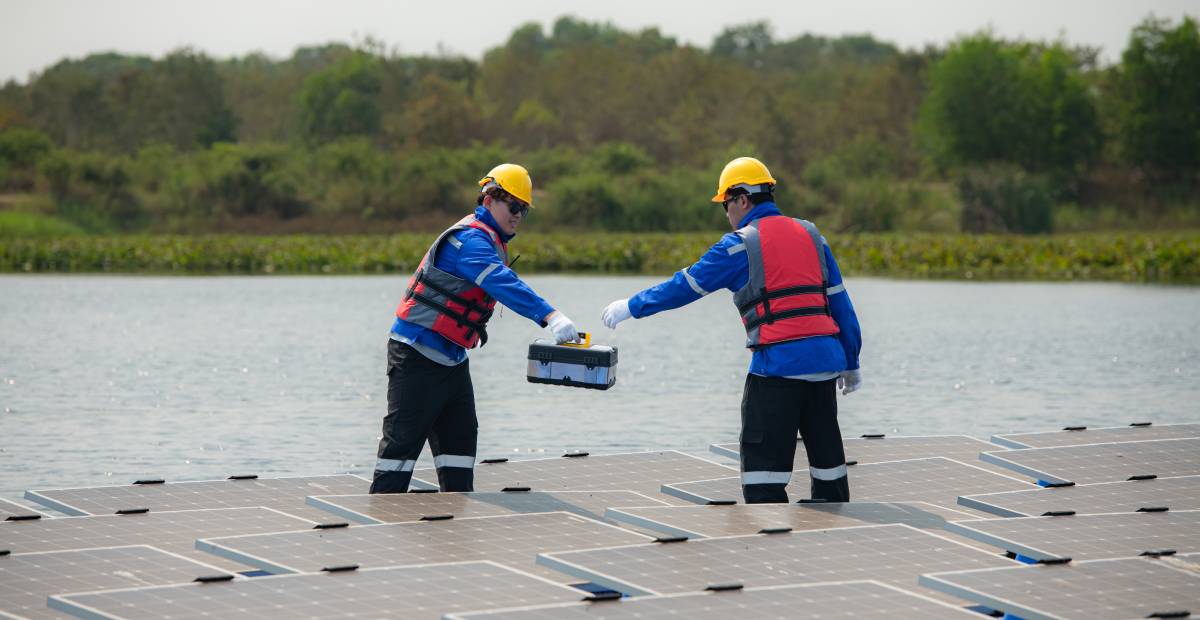
The floating array system uses buoyant pontoons together with walkways and inverter rafts and flexible DC/AC cabling. The standards DNV RP-0584 and IEC codes provide the necessary framework for buoyancy and grounding and safety requirements. Engineers perform modeling of wind loads and wave action and water-level variations to validate layout and structural integrity before construction.
Anchoring & Mooring Strategies for Stability
The choice of mooring system depends on project success factors which include bank-attached, bottom-anchored or hybrid mooring systems based on depth, sediment type and seasonal current. Large reservoirs use multi-vector catenary lines to secure pontoons against monsoon winds. FPV on canal tops uses cantilever beams or pylons to span water channels because bottom anchoring is not possible.
Cooling, Efficiency, and Evaporation Benefits
The natural cooling properties of water help maintain module temperatures at levels below ground-mount arrays which results in a 2–4% increase in energy output. The floating installation method decreases reservoir evaporation which leads to the preservation of millions of litres of water each year especially in areas with limited water resources. The dual advantages of this system improve both power generation and water preservation capabilities.
Cost Drivers: Capex vs Lifecycle O&M
FPV’s capital cost is typically 12–15 % higher than ground-mount because of pontoon platforms, mooring hardware, and water-side assembly logistics. However, it eliminates land-acquisition expense. O&M costs differ: cleaning robots remove bio-film and bird droppings, and corrosion-resistant cabling prolongs service life. As pontoon prices fall and scale improves, FPV’s levelised cost edges closer to ground-mount systems.
Case Studies: Kerala & Omkareshwar Lessons
The 92 MW Kayamkulam FPV plant in Kerala sells power at highly competitive tariffs, proving bankability. The 600 MW Omkareshwar array in Madhya Pradesh shows phased deployment across variable depths through the use of modular pontoons and adaptive anchoring. The project teaches us how to handle depth contours and how to finance projects in phases and how to engage with the community to obtain water-use rights.
Performance Risks and Mitigation Measures
The system faces two main disadvantages because high humidity speeds up encapsulant deterioration and connector corrosion becomes more likely. The system requires anti-fungal coatings together with UV-resistant encapsulant and sealed IP-68 cabling for mitigation. The plant operates with electrical-resistance tests and quarterly inspections that keep performance ratios above industry benchmarks throughout its entire life.
Policy Outlook and Scale-Up Potential
Government agencies have issued gigawatt-scale FPV tenders, and state tariffs now include specific categories for floating projects. Hydropower-solar hybrids—sharing transmission and balancing services—offer additional revenue streams. FPV is expected to contribute 5–7 % to India’s new solar capacity by 2030, driven by land scarcity and policy momentum.
SunShell Power: Delivering Bankable Floatovoltaics
The SunShell engineers use wave dynamics, pontoon fatigue and cable drag models to optimize their designs. We select HDPE floats that are rated for 25-year UV life and integrate SCADA dashboards with module-temperature sensors to provide proactive cooling insights. Long-term O&M packages include bio-fouling management, ensuring that energy yield and water-conservation benefits remain consistent
FAQs
How does floating solar plant cost compare to ground-mounted PV?
FPV capex is about 12–15 % higher, but land-acquisition savings and higher yields reduce the lifetime cost difference
What anchoring methods suit reservoirs deeper than 20 m?
Combination mooring with catenary lines and elastic ropes anchors arrays securely across significant depth variations.
Do floating arrays impact aquatic life?
Environmental studies show minimal effects when coverage stays below 10 % of surface area and adequate light corridors are maintained.
What is the typical payback period for a 10 MW floating solar power station?
Depending on tariff, capex, and O&M, payback usually falls between seven and eight years.
How does SunShell address module degradation in humid environments?
We specify anti-corrosion connectors, UV-resistant encapsulants, and schedule quarterly inspections for early intervention.